Can your editor trace that claim in two minutes?
Vorbtech Team · 29 October 2026 · 6 minute read
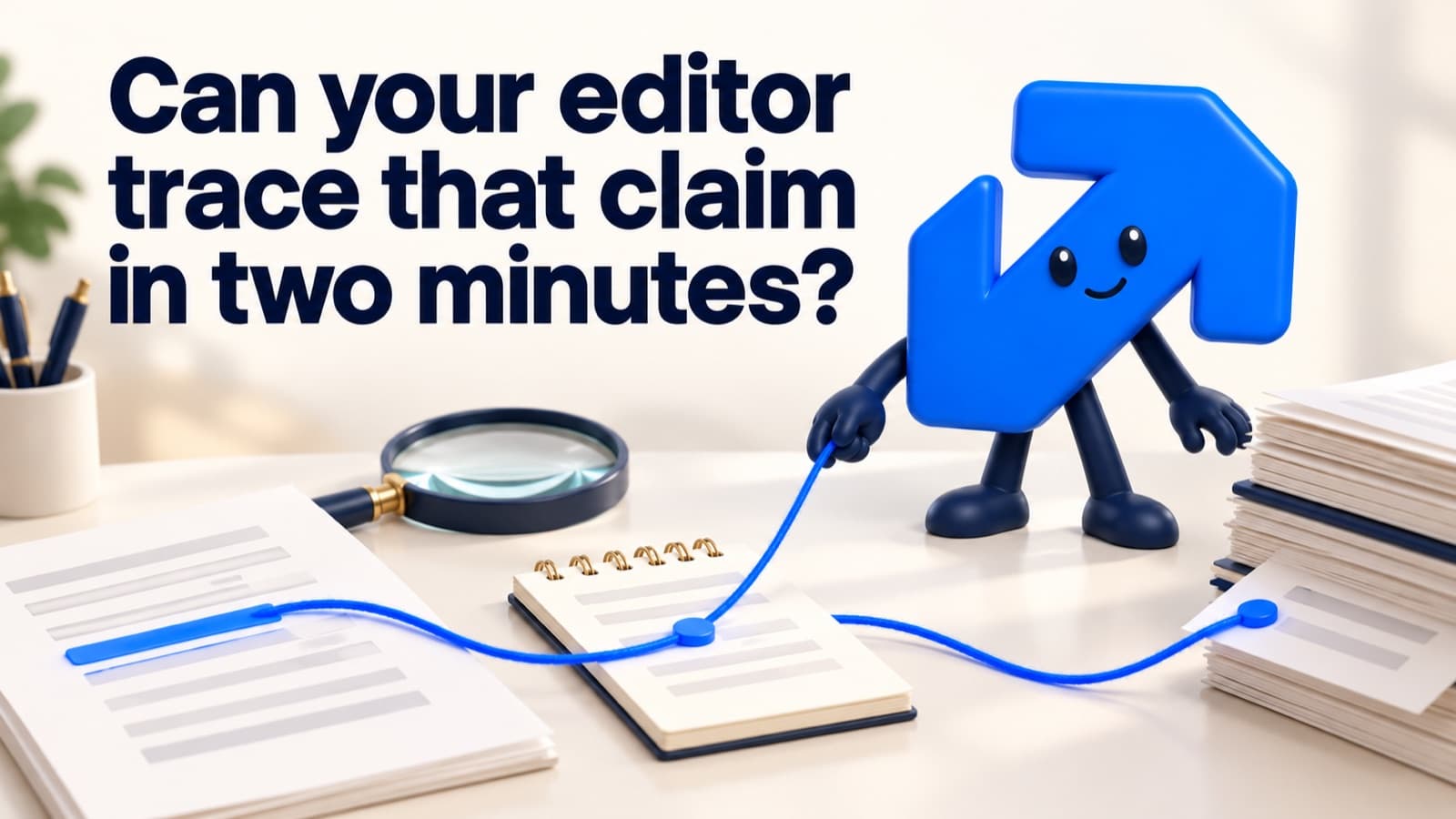
It is Thursday evening and the investigation runs on Sunday. The draft is strong. Then the editor stops at the third paragraph and asks a simple question: where does this figure come from?
The reporter knows it is right. She remembers finding it. But the line in the draft came from a colleague's summary, which came from a shared document, which drew on a spreadsheet someone built from a set of procurement PDFs three weeks ago. The link to the original filing is somewhere in a WhatsApp thread. Forty minutes later, the team finds it. The figure holds. Nobody has time to check the other eleven.
That scene is hypothetical, but most editors and investigations leads will recognise it. The evidence was never lost. The trail around it was.
Where source context goes missing
Investigations rarely slow down because a team cannot find information. They slow down because the evidence, its translations, the AI-assisted summaries and the editorial decisions end up in different places.
Claims detach from their sources
A useful excerpt is copied into a planning document. The sentence survives; the URL, page number, date and surrounding context do not. Weeks later it reads like an established fact, and nobody can say whether it came from the filing itself or from a news report about the filing.
Research gets repeated
A researcher spends a morning establishing which companies share a director. A week later, a reporter on the same project does it again, because the first result sits in someone's notebook and there is no shared record of what has been checked, translated or ruled out. Research teams in NGOs and institutions see the same thing when a policy brief is updated by someone who was not on the original project.
Translations lose their reasoning
A key document or interview is translated from Hausa, Yoruba, Igbo, Pidgin or French. The translator makes a judgement call on an ambiguous phrase: did the speaker mean the money was promised, or that it was paid? The English version goes forward. The judgement call does not. When a lawyer or editor questions the line, the reasoning has to be rebuilt from memory, if it can be.
AI summaries cannot be traced back
Someone runs a 200-page audit report through an AI tool and gets a tidy two-page summary, useful for orientation. But it does not say which pages each point came from, and one point merges two separate findings into a single claim. Once it is pasted into the working notes, it starts to look like evidence.
None of this is carelessness. It is what happens when capable people move fast across chat, email, shared folders, translation tools and AI assistants, each holding its own fragment of the story.
Why it matters beyond the deadline
When the trail breaks, the cost appears in three places. Editors spend pre-publication time reconstructing provenance instead of testing the argument. Legal review becomes slower and less confident, because the team cannot quickly show what supports each sensitive claim. And the story's credibility rests on facts that only one person can vouch for, which is fragile when that person is on leave, has moved on or is simply exhausted.
For research teams, a finding in a policy brief has to stand up when someone asks where it came from, months after the analyst who produced it has changed roles.
A two-minute workflow test
Choose one important conclusion in a current investigation or research project, and ask:
Can an editor trace this conclusion to its original source, see how it was interpreted and know who approved it, in under two minutes?
Run it on three or four claims, including one that relied on a translation and one that passed through an AI-assisted summary. If the answer is consistently yes, your workflow is doing its job. If not, the gap is rarely a single tool. It is continuity: the source, its interpretation and the decision about it live in different places.
Habits that keep evidence traceable
These practices work with the tools you already have. A shared spreadsheet and a disciplined folder structure can carry most of them.
Keep a source log from the first search
Give each source a short identifier and record where it came from, when it was retrieved, who found it and, where possible, an archived copy. Cite the identifier in working notes and drafts. A claim with an identifier can be traced. A claim without one is a lead, not evidence.
Record provenance for AI-assisted work
Treat AI output as a pointer to evidence, not as evidence. The Associated Press set this out plainly in its standards around generative AI in August 2023: "Any output from a generative AI tool should be treated as unvetted source material." In practice, note which tool produced a summary, which document it was based on and who checked each point against the original pages. If a point cannot be matched to a page, it stays out of the draft.
Write translation notes
Alongside each translated document or interview, record the translator, the source language and any phrase where the meaning was uncertain, with the alternatives considered. Machine translation can give a fast first pass across a large set of documents, but a fluent speaker should review every passage the story relies on.
Leave handoff notes
When a strand of research changes hands, the next person needs to know what has been checked, ruled out and left open. Three short lines are often enough. They prevent the repeated morning of work, and the quiet assumption that something was verified when it was only found.
Set review checkpoints
Agree in advance where an editor signs off on a claim: for example, when it enters the draft and again before legal review. Record who approved it and when. The Paris Charter on AI and Journalism, published by Reporters Without Borders and partner organisations in November 2023, is direct about this: media outlets "are liable and accountable for every piece of content they publish", and responsibilities tied to AI use should be "assigned to humans". A checkpoint makes that responsibility visible.
Using AI without losing the trail
AI can help a small team read more: summarising long documents, producing first-pass translations and showing where a name appears across hundreds of pages. For newsrooms with limited staff and large public records, that is a real gain.
The condition is that speed does not cost the trail. Every AI-assisted step should point back to the material it drew on, and a named person should review whatever the story relies on. The Paris Charter says human decision-making "must remain central" to both long-term strategy and daily editorial choices. That is a workflow requirement as much as an ethical one. A reviewer can only exercise judgement if they can see what the AI was working from.
Where Argus fits
Argus, the VIS research and document workspace, is built for teams whose material is scattered across tools. It has six modules: Command organises the assignment, Insight analyses documents, Digest produces source-linked summaries, Lingua translates, Query answers questions across the collection and Nexus supports collaboration. It does not replace editorial judgement or verification. People review what it produces.
For investigative teams, VIS is running a founding newsroom pilot, now open for applications. The terms are:
- one Nigeria-based investigative newsroom
- six weeks, with up to 10 named users and all six modules
- a fixed fee of NGN 1,500,000
- public, non-sensitive material only, so it suits a public-records investigation rather than work involving confidential sources
The pilot is an application, not a purchase. Taking part requires a readiness review and a signed order form. Scorecard targets are agreed with your team against a baseline of how you work today, so the evaluation starts from your own workflow.
If this sounds like your newsroom's week, you can apply for the Argus founding newsroom pilot. If you lead a research or information team in an NGO or institution, or would rather talk through your workflow first, discuss your Argus workflow with us.
Either way, run the two-minute test on your current project this week. It will show you where the trail breaks, and that is the right place to start, with or without new software.

Written by
Vorbtech Team